
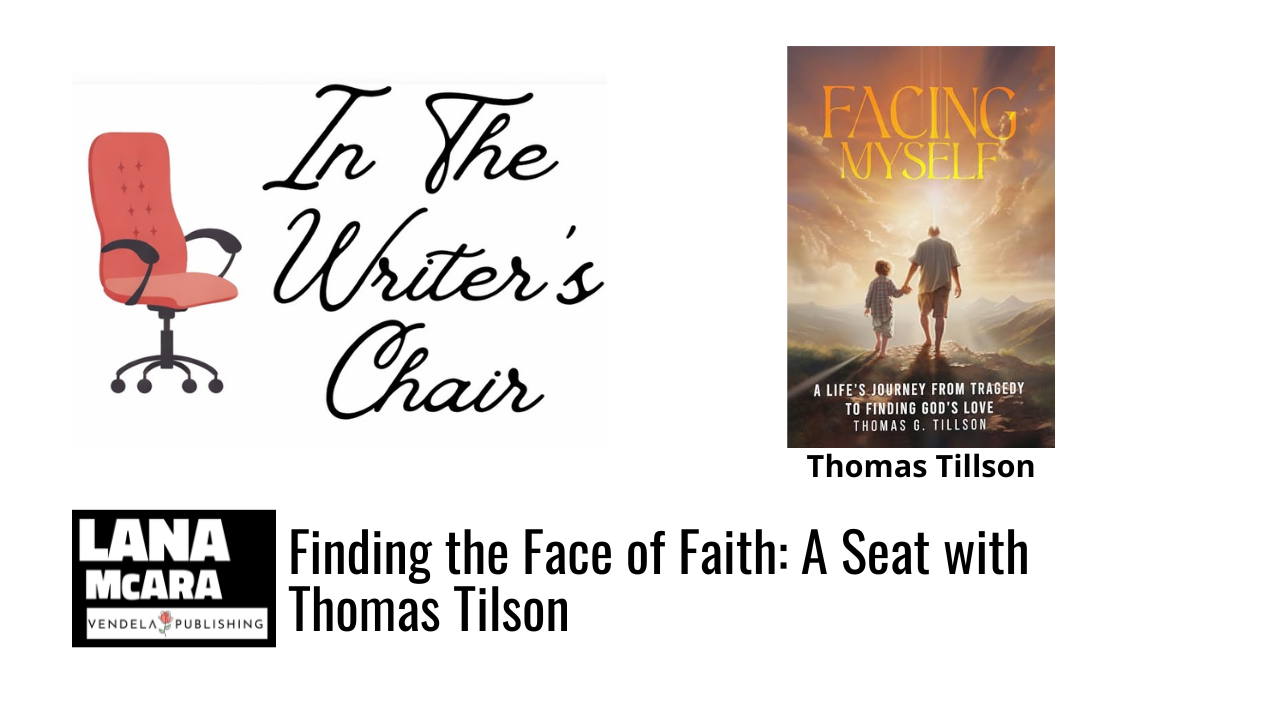
When Thomas Tillson was born in 1951, he had no nose, lips, or jawbone—an anomaly so severe that survival seemed unlikely. Doctors advised his parents to let him die. Instead, his life became a 74-year testament to surgical innovation, stubborn hope, and faith that would let go.
On this week’s In The Writer’s Chair, I pulled up a seat with Thomas to discuss his memoir, Facing Myself: A Life’s Journey from Tragedy to Finding God’s Love. What unfolded was a meditation on identity—what it means to face yourself when the world has already decided who you are.
A Child of Experimental Medicine
Thomas became a patient of one of the foremost reconstructive surgeons at Northwestern. The agreement was straightforward: the surgeries would be free because his case would be documented for medical journals. Sixty-five reconstructive procedures followed. Each carried risk. Each advanced a field still defining itself.
His progress helped shape modern craniofacial reconstruction. Today, his case stands as evidence that severe deformity does not determine a person’s capacity for a full, expressive life.
But surgical innovation does not soften a difficult childhood.
Thomas recalled the snickering classrooms of the 1950s, years of speech therapy, and rebellion that left him homeless at sixteen. His resilience was not born in the operating room. It was forged in cafeterias and on sidewalks, in daily decisions to keep going.
The Dark Car on the Eisenhower
At twenty-two, overwhelmed by pain and rejection, Thomas made a plan to end his life. He drove onto the Eisenhower Expressway in Chicago, determined to follow through.
In the darkness of that car, he suddenly heard a voice.
That miracle moment redirected everything. For Thomas, that moment brought in a subtle shift that was profound—from asking why he was born this way to asking what he might do with the life he had.
Love, Risk, and Music
Thomas met his wife through persistence and humor. They have now been married for fifty-one years. Doctors warned them of a 10% chance their children could inherit his condition. They chose hope. Their family today stands as quiet defiance of fear.
Music became another form of survival. From a 1960s garage band to contemporary Christian songwriting, music gave him rhythm when speech felt mechanical, and expression when explanation was exhausting.
Why He Wrote
For decades, Thomas kept journals but never considered writing a book. His memoir came later, when he realized his grandchildren deserved the full story from medical subject, to husband, father, musician, and believer.
A reader recently told him, “I didn’t think God was listening, but your book was beautiful.” That response captures the heart of Facing Myself.
It is a reminder that even in the darkest moments—on highways, in classrooms, in hospital rooms—hope can interrupt the narrative.
Sometimes, that interruption changes everything.
Would you like to be a guest on the “In The Writers Chair” podcast?
Click Here and complete the application.