
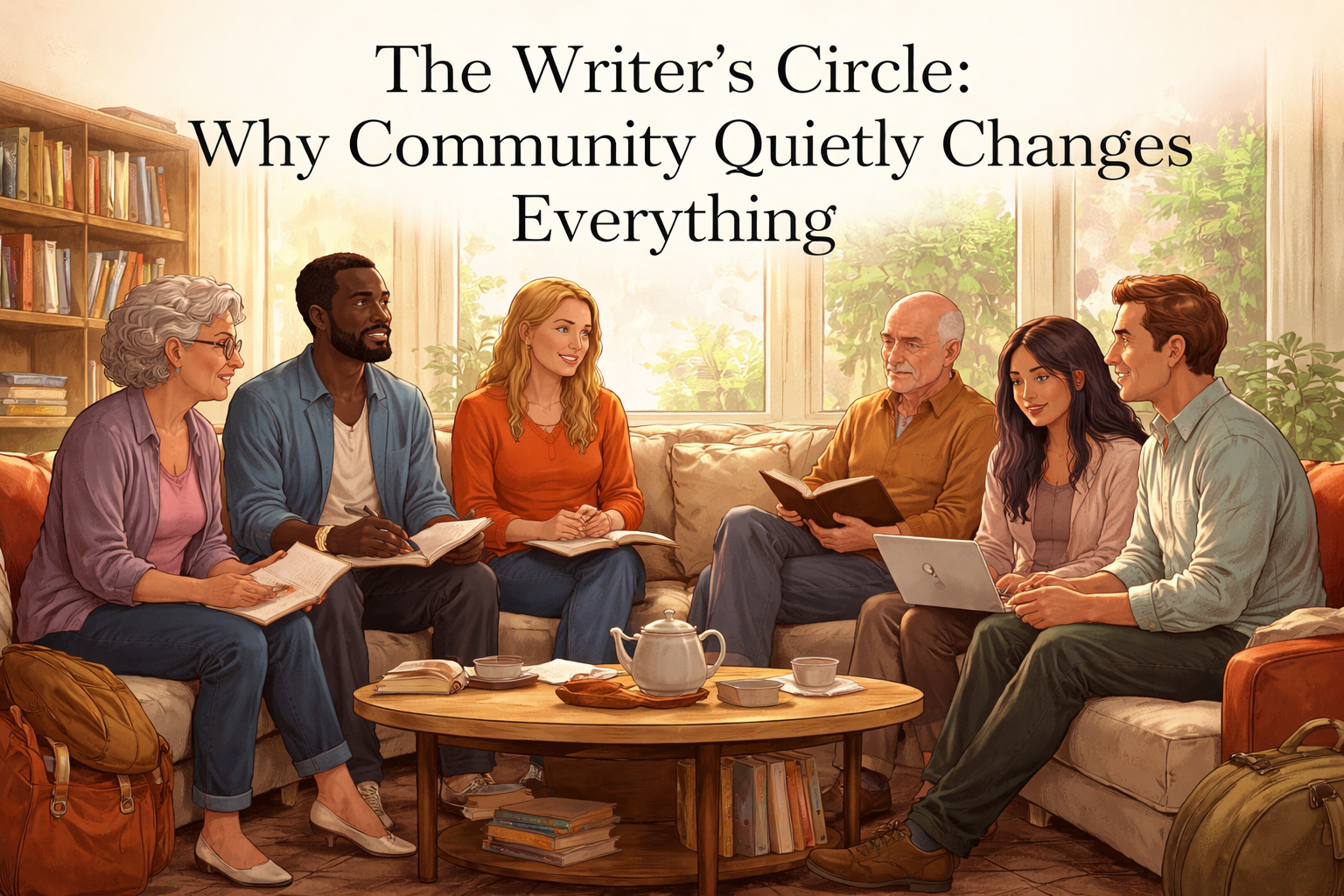
If you sat in on the call that night, you wouldn’t have thought it was anything special. A few people in different states, one in Michigan, one in New Jersey, two in Florida. Someone’s voice was scratchy from a cold. Another was waiting for a shipment of books that seemed to be traveling by mule. Someone else had just illustrated her own children’s book because she didn’t want to pay an artist.
And yet, this is what the writing life actually looks like.
A handful of people logging in after dinner, each carrying a book idea that has taken years—sometimes decades—to reach the surface.
One woman was launching a second edition of a book about growing up in East Germany and learning to build a life beyond invisible walls.
Another had written a historical novel based on her grandmother’s journey to America in 1921.
A man was finishing a biography of Greta Garbo—his great aunt—after years of research.
It wasn’t a networking event.
It wasn’t a pitch session.
No one was trying to impress anyone.
They were simply introducing themselves. Three minutes at a time.
And yet, those small introductions told a deeper truth than any craft lecture ever could: Every book is a life story, even when it’s fiction.
You could hear it in the way they spoke.
The children’s author wasn’t talking about market positioning. She was talking about the moment she saw a mother and two little kids reading her book together in a bookstore. “It was so precious,” she said.
The veteran talked about watching the towers fall, about his brother surviving, about feeling the call to serve.
No one mentioned algorithms.
They talked about meaning.
And that’s what most writing groups forget.
We often treat writing groups as critique factories—places where pages are dissected, commas are corrected, and plot holes are patched. But the deeper function of a writer’s circle is something quieter.
It is a place where people remember why they are writing at all.
When you hear someone took twenty years to gather the courage to write their book, it resets your own expectations. Suddenly, the slow pace of your own manuscript doesn’t feel like failure. It feels normal.
When you hear someone say they switched genres for the fourth time, you realize that creative identity isn’t a straight line. It’s a wandering road with scenic detours and wrong turns and the occasional flat tire.
When an eighty-year-old author asks how to transition from one book to the next, you see something else entirely: the writing life doesn’t have an expiration date.
It keeps unfolding.
The modern writing world is obsessed with speed. Rapid releases. Fast marketing cycles. Quick audience growth. There’s a constant hum of urgency—post more, launch faster, build your platform before breakfast.
But a circle of writers tells a different story.
It says:
Take the time.
Tell the truth.
Keep going.
In a room like that, no one is a beginner. Even the first-time author carries decades of experience, heartbreak, curiosity, or courage into their pages.
And no one is ever finished. The seasoned author is figuring out the next book, the next audience, the next step.
What makes these circles powerful isn’t the advice exchanged. It’s the quiet permission they offer.
Permission to change genres.
Permission to write the book that scares you.
Permission to take longer than you planned.
Permission to keep writing at eighty.
When the call ended, nothing dramatic had happened. No contracts were signed. No bestseller lists were updated. No one announced a six-figure deal.
But something more important had taken place.
A group of writers had reminded each other that they were not alone.
And sometimes, that is the most practical writing advice of all.