
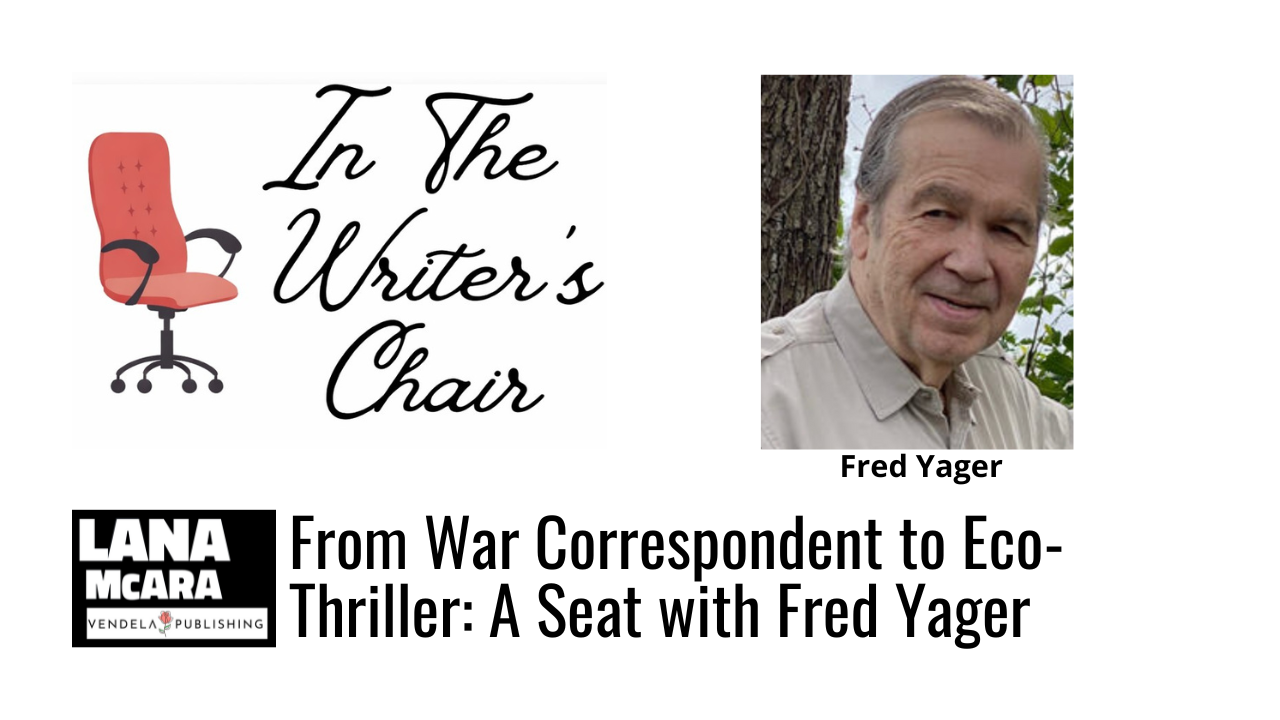
What happens when a war correspondent, Hollywood screenwriter, and strategic storyteller turns to fiction?
In this episode of In The Writers Chair, Lana McAra sits down with Fred Yager, a writer whose career spans the Vietnam War, the Associated Press, major film studios, and global communications strategy. His journey is anything but linear—and that’s exactly what makes his storytelling so compelling.
Fred shares how his early experiences covering real-world conflict shaped his instinct for narrative truth—and how those instincts carried into screenwriting, where he learned the realities of Hollywood, where he had thousands of scripts optioned, but only a handful produced. Instead of letting stories sit unseen, he’s now transforming those screenplays into novels—where creative freedom is far greater.
At the heart of this conversation is a powerful idea: great stories don’t come from formulas. They come from observation, lived experience, and the courage to follow an idea wherever it leads.
You’ll hear how Fred:
Turned real events from Southeast Asia into the foundation for The Asian Queen
Navigates the shift from screenplay structure to novel depth
Builds characters by entering their psychology—before revealing their identity
Uses both instinct and structure to develop complex narratives
Draws story ideas from everywhere—journalism, chance encounters, and even hired work
The conversation also explores the evolving publishing landscape, including the rise of audiobooks and the practical reality many authors face: building a writing life supported by other forms of writing, like ghostwriting.
Fred’s latest novel, Botanica, pushes into speculative territory, imagining a world where nature itself responds to human destruction. It’s a reminder that even the most imaginative fiction often begins with a simple question: What if this were true?
If you’ve ever wondered how to turn experience into story—or how to keep your work alive when one path closes—this episode offers both perspective and possibility.
Sometimes the story doesn’t find its final form right away. It evolves across formats, across years, across versions of yourself.
The writers who last? They’re the ones willing to keep telling it any way they can.