
The first book is a miracle.
It appears out of years of silence, doubt, false starts, abandoned drafts, and late-night promises to yourself. It carries all the weight of your hopes. It represents the moment you finally became the person you always meant to be.
But after the celebration comes the quiet question:
What next?
One of the writers in a group raised it gently. He had published a book about hiking a wilderness trail—a true story, full of photographs, the kind of book that sits comfortably on a coffee table and invites people to pick it up.
Now he had a second book. A novel. Different tone, different structure, different expectations.
How should he make the transition?
It’s a problem almost no one talks about, because the publishing world is obsessed with the first book. The debut. The launch. The arrival.
But careers are built on second books. And third books. And fourth.
The first book answers one question:
Can you finish?
The second book asks a harder one:
Can you continue?
For many authors, the second book feels like stepping onto a stage without a script. The excitement of the debut is gone. The novelty has worn off. Now there are readers who have expectations.
You have to decide what to do with them.
The practical answer often begins with something simple: communication.
How do you stay in touch with the readers from your first book? Do you have an email list? A way to reach them?
It sounds like a marketing question, but it’s really a continuity question.
The second book isn’t about writing. It’s about relationships.
You’re not starting from zero anymore. You’re carrying forward the small community that gathered around your first story. They matter. They are the first witnesses to your work.
And they’re more flexible than you think.
Readers don’t always follow genres. They follow authors.
If they liked your voice, your honesty, your sense of humor, your courage—those qualities travel with you into the next book, even if the setting changes.
An author who writes a memoir about hiking can write a historical novel about war. Or a thriller. Or a romance. The genres may shift, but the emotional signature stays the same.
The real challenge of the second book isn’t convincing readers to follow you.
It’s convincing yourself that you’re allowed to change.
Many authors feel an invisible pressure to repeat the first book’s success. To stay in the same lane. To become “the hiking guy” or “the historical lady” or “the thriller author.”
But careers built on fear tend to shrink. Careers built on curiosity tend to grow.
The authors in that circle were proof of it. One had written contemporary women’s fiction, then a self-help book, then a children’s book, and was now working on historical fiction.
Another had turned a screenplay into a novel.
Another had written a spiritual memoir and then a business book.
Another was preparing an audiobook version of a revised edition.
No one was standing still.
And maybe that’s the real answer to the second book problem.
You don’t “transition” from one book to another the way a corporation transitions product lines. You simply keep writing the next story that matters to you—and invite your readers along for the ride.
Some will follow.
Some won’t.
New ones will join.
A writing life isn’t a single launch. It’s a long road with many signposts.
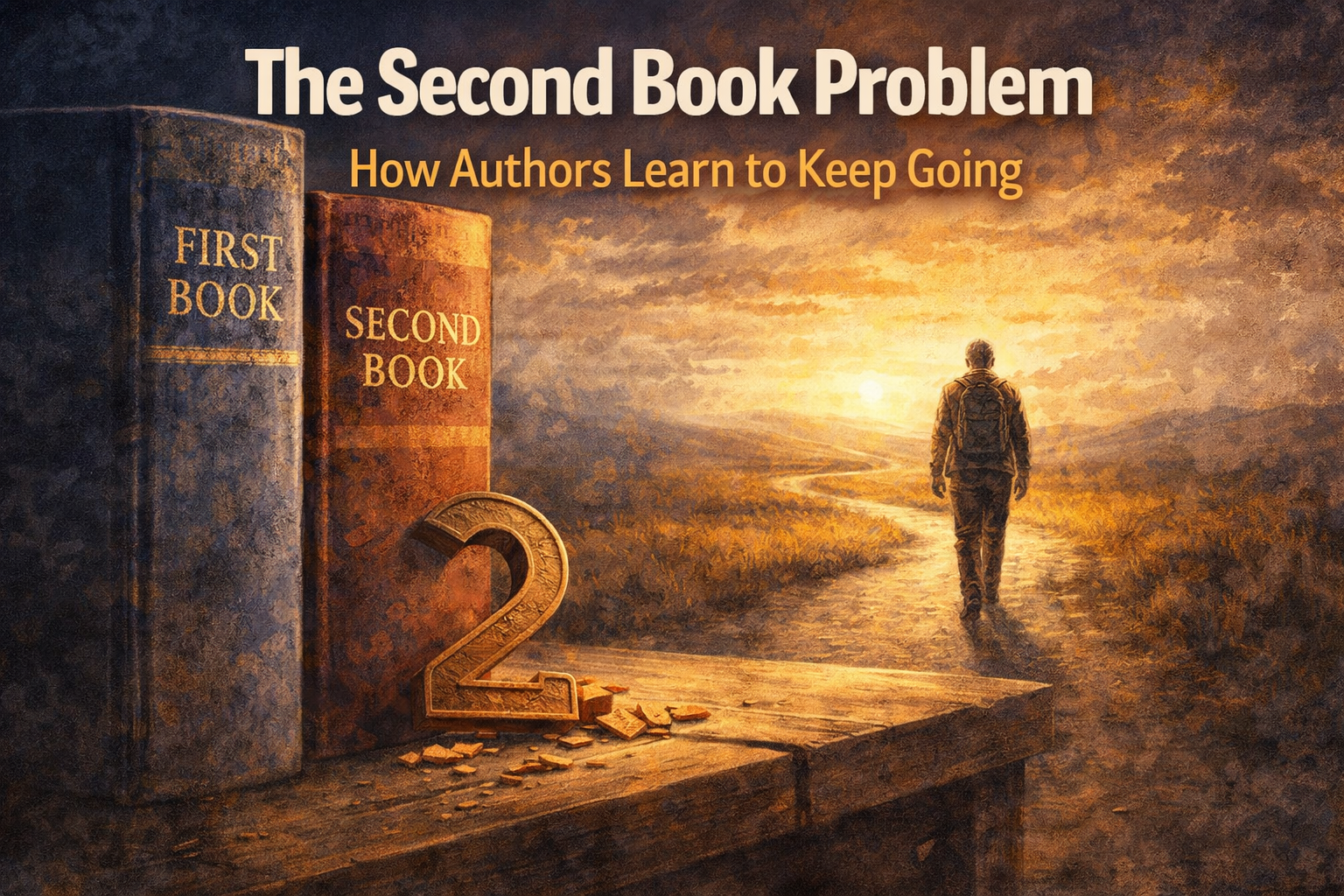
The first book is the moment you step onto the path.
The second book is the moment you realize the path keeps going.
And if you’re lucky—if you keep walking—you’ll look back one day and see a trail of stories behind you, stretching farther than you ever expected and a growing group of readers walking with you.