
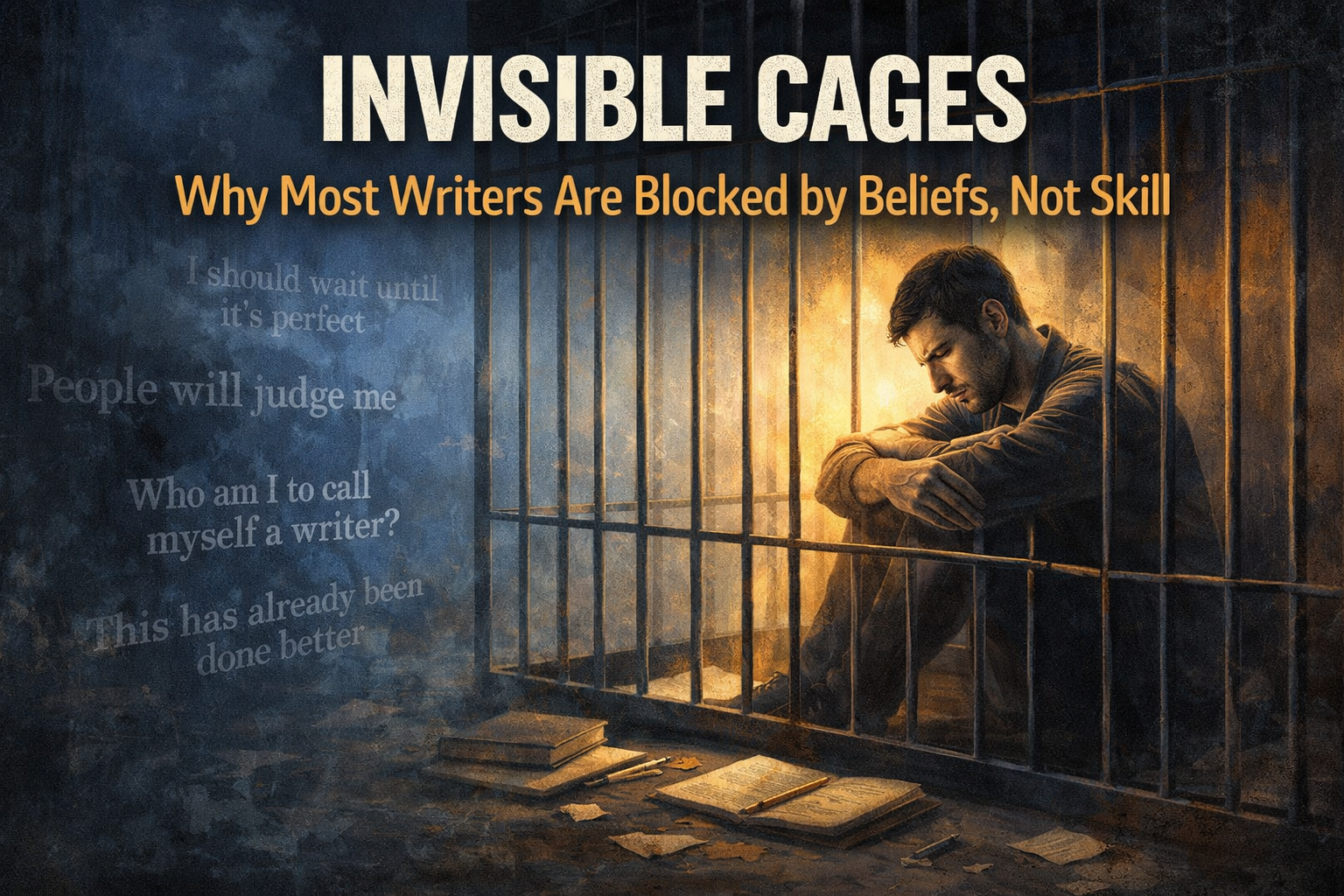
Invisible Cages: Why Most Writers Are Blocked by Beliefs, Not Skill
Most writers assume they’re stuck because they don’t know enough yet.
They need another class. Another book on craft. Another conference. Another round of feedback. Another certification, credential, or permission slip from the publishing gods.
If you listen closely—really listen—to the way blocked writers talk, the problem isn’t technique.
It’s belief. Invisible, reasonable-sounding beliefs that quietly fence them in.
The Most Dangerous Cages Are the Ones That Make Sense
The hardest barriers to recognize don’t announce themselves as fear. They show up dressed as logic.
· Who am I to call myself a writer?
· This has already been done better.
· I should wait until it’s perfect.
· People will judge me.
None of these thoughts sound irrational. In fact, they often sound mature, cautious, even responsible.
That’s what makes them so effective.
They don’t feel like cages. They feel like good judgment.
Skill Is Visible. Belief Is Not.
When a writer lacks skill, the symptoms are obvious: weak structure, flat scenes, unclear arguments. Those can be fixed by instruction and practice.
Belief-based blocks are different. The writing may be strong—sometimes very strong—but progress stalls anyway.
Projects lay in half-forgotten files. Books stay unpublished. Opportunities fade away. The writer keeps circling the work instead of stepping into it.
From the outside, it looks like hesitation.
From the inside, it feels like self-protection.
The “Who Am I?” Question
One of the most common invisible cages writers face is the legitimacy trap.
· Who am I to say this?
· Why would anyone listen to me?
· I’m only kidding myself.
These doubts hit especially hard for writers whose work crosses boundaries—memoir-inflected nonfiction, fiction rooted in lived experience, stories that carry meaning beyond entertainment.
Those books offer perspective.
And perspective requires ownership.
The moment a writer claims authority over their own story, something internal pushes back because it’s vulnerable.
The Cost of Staying Caged
Invisible cages don’t usually stop writers from starting.
They stop them from finishing.
From sharing.
From standing behind the work.
Over time, this creates a quiet erosion of confidence. The writer begins to assume the hesitation means something is wrong with the project—or with them.
So they revise endlessly. Or pivot to a new idea. Or wait for clarity that never arrives.
Meanwhile, the work that could have mattered sits safely on the shelf.
Why Breaking Free Isn’t About Confidence
Confidence is a byproduct, not a prerequisite.
No writer wakes up one day suddenly convinced they’re ready. The shift happens when a writer recognizes the cage for what it is—and chooses to step out of it.
They submit it to a publisher.
They speak about it without apologizing.
They stop asking for permission from people who were never going to give it anyway.
The Truth Writers Rarely Hear
Most writers who feel blocked are not underprepared.
They are over-contained.
They’ve learned to manage risk so well they’ve accidentally managed themselves out of momentum.
Breaking free doesn’t mean ignoring craft, structure, or professionalism. It means recognizing when those concerns have become disguises for reluctance.
The work doesn’t need permission.
It needs placement.
It needs voice.
It needs the writer to step forward.
And that step is almost never about skill.
It’s about unlocking the cage that says, Not yet.