
She Tried to Leave Her Publisher
And She Paid $800 to Get Her Own Book Back
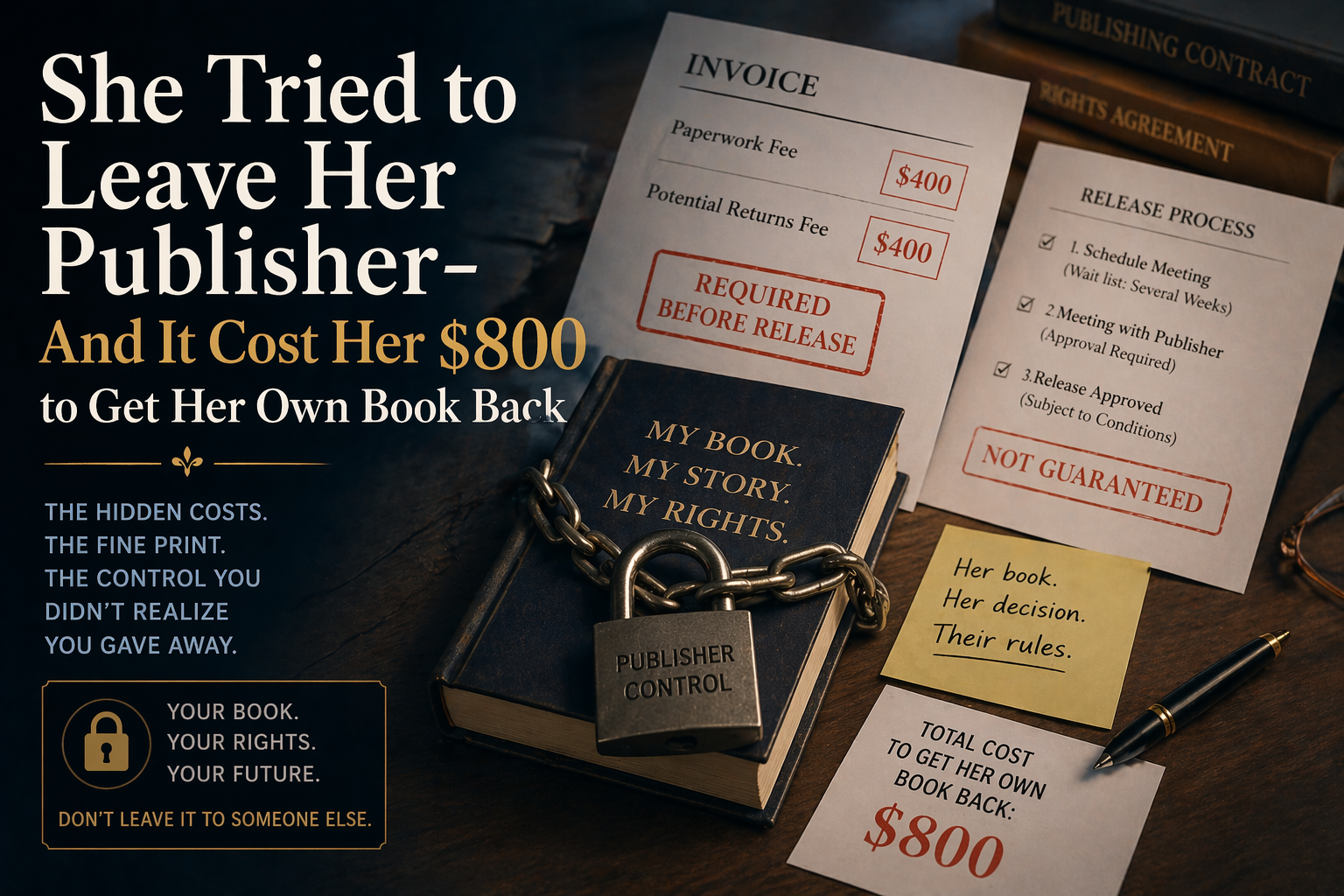
It all started with a simple decision. An author—experienced, capable, with more than thirty books to her name—decided she wanted to take one of her titles in a different direction.
Not abandon it. Not rewrite it.
Just… move it.
Reposition it. Handle it herself. Try something new.
Reasonable.
Except it wasn’t simple.
The Price of Leaving
When she contacted her publisher, the response was polite. Professional. And very specific.
She would have to pay a fee.
$400 to “handle the paperwork.”
Another $400 to cover any potential book returns still circulating in the system.
Total: $800.
Then came the next step.
She had to schedule a meeting. Not immediately—she had to wait. A few weeks. Then a conversation with the owner. To explain herself.
Only after all of that—after the payment, the delay, the approval—she would get her property back.
Her book.
The one she wrote.
What This Really Means
On the surface, it sounds like an inconvenience. A frustrating policy. A bit of red tape.
But underneath, the situation reveals something far more important.
Control.
Or more precisely: Who actually has it.
When an author cannot easily step away from a publishing arrangement, the relationship has shifted. It’s no longer a partnership. It’s a dependency.
The Cost You Don’t See Coming
Most authors, when evaluating publishing options, focus on the upfront cost.
· What does it take to get the book produced?
· What’s included?
· What’s the investment?
Those are valid questions, but they’re incomplete. The more important question is this: What happens if I want to leave?
Books evolve. Markets shift. Authors grow. Sometimes, the right move is to pivot. When that pivot comes with a price tag—and a waiting period—it changes everything.
The more important question is this: What happens if I want to leave?
The Emotional Layer No One Talks About
Something quieter is happening in moments like this. Something that doesn’t show up on an invoice. It’s the feeling of needing permission. Justifying your decision. Explaining why you want to move forward with your own work.
For many authors, that moment lands harder than the fee because it challenges something fundamental: Ownership.
This challenges something fundamental: Ownership.
A Different Way to Think About Publishing
Now, contrast that experience with a different model. One where, if an author decides to leave, the process takes less than a day.
No fees.
No meetings.
No friction.
Just a simple acknowledgment: It’s your book. Your decision.
That kind of structure functions differently. It keeps the author in motion.
It’s your book. Your decision.
Why This Matters More Than You Think
Most authors don’t expect to leave their publisher. At least, not at the beginning. But careers are not static. What feels right today may not fit tomorrow.
The ability to move—freely, quickly, without penalty—is not a luxury. It’s leverage.
The Question Worth Asking
Before signing anything, before committing to any publishing path, there’s one question that deserves a clear answer: If I decide to walk away… what will it cost me?
Not just in dollars. But in time. In energy. In control.
The real cost of publishing isn’t always what you pay to begin. Sometimes, it’s what you pay to get out. Most of the time, when you discover that…
…it’s already written into the contract.
Check out Vendela Publishing. We’re author-owned and operated—by authors, for authors.