
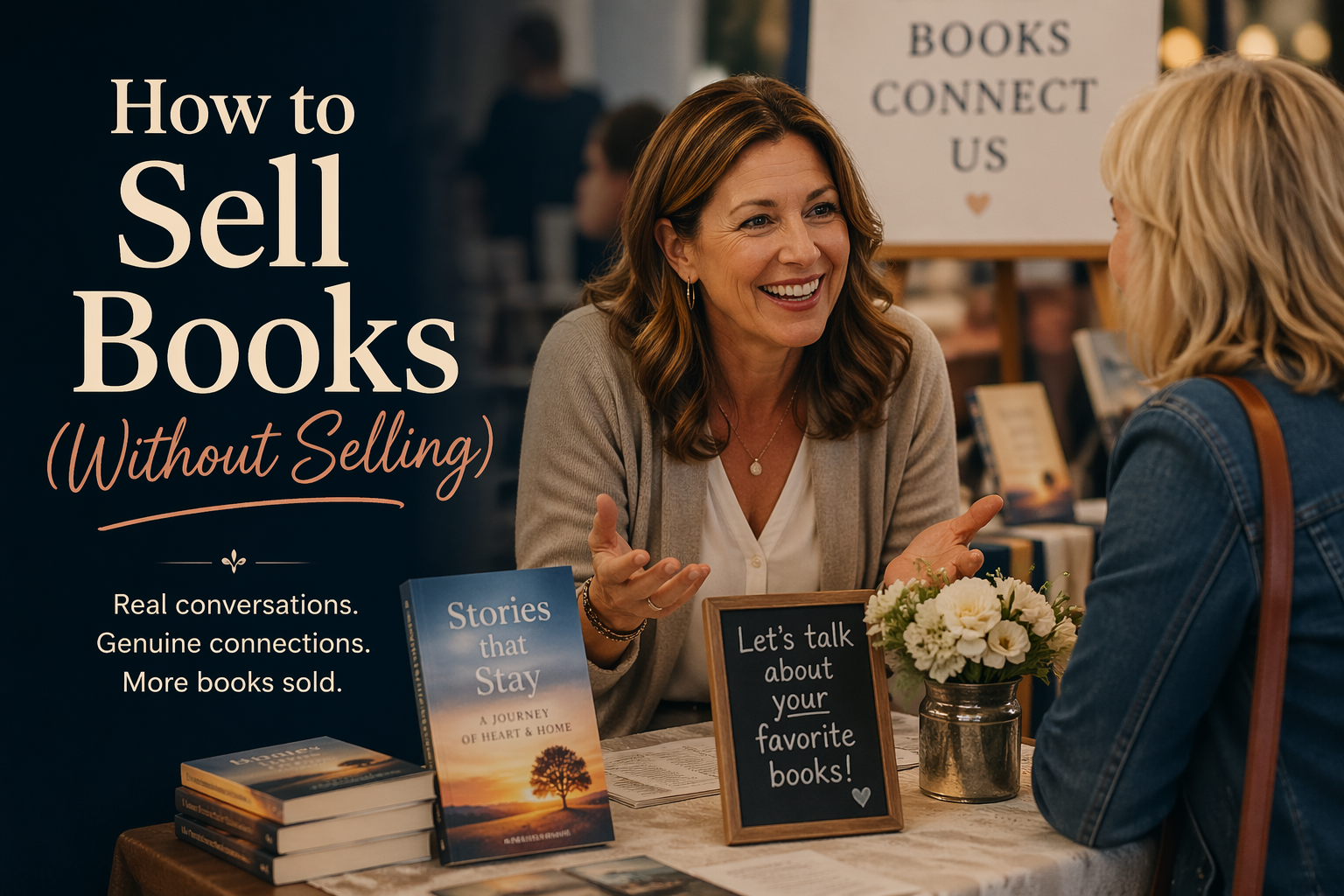
Every author recognizes the moment.
You’ve set up your table. The books are neatly arranged. Maybe you have a banner, a tablecloth, something that says you belong here. You’re ready.
Someone walks by.
They slow down… glance at your books… and keep moving.
In that split second, most authors make the same move.
They start talking.
They explain the book. They summarize the plot. They reach—a little too quickly—for a reason the passerby should care.
That’s the exact moment the sale quietly slips away.
What feels like “being helpful” to the author feels like “being sold” to the reader.
And readers don’t lean into that feeling. They lean away.
Books don’t sell through talking. They sell through connection.
Connection doesn’t begin with your book.
It begins with the other person.
Instead of leading with: “This is my book. It’s about…”
If you have a cookbook, try this:
“Do you enjoy cooking?”
“Are you the cook in your house?”
“What’s your favorite thing to make?”
If you write fiction, maybe this:
“What kind of books do you love reading?”
“Have you found anything here today that caught your eye?”
Simple questions. Open doors. And something subtle—but powerful—happens.
The customer starts talking.
Why This Works (Even If It Feels Backward)
A quiet psychological shift happens the moment someone begins talking about themselves. Their internal guard—the one that says “I’m about to be pitched”—begins to lower.
It’s no longer a sales interaction. It’s a conversation.
And conversation is where trust lives.
When you’re genuinely listening—curious, present, engaged—you’re no longer trying to get something from the interaction. You’re discovering something.
Who they are. What they enjoy. What matters to them.
And from there, the next step becomes obvious.
The Counterintuitive Truth About Selling Books
Here’s the part that trips people up: You don’t need to convince someone to care about your book.
You need to discover whether they already do.
“You need to discover whether they already care.”
When someone tells you they love quick, simple meals because they’re busy and overwhelmed, and you happen to have a cookbook built for exactly that…
You don’t need a pitch.
You need a bridge. Something like, “You might like this one—it’s designed for exactly that.”
That’s it.
No performance. No pressure.
Just alignment.
What Most Authors Do Instead
If you’ve ever walked through a book fair, you’ve seen the other approach.
The rapid-fire summary.
The enthusiastic monologue.
The verbal equivalent of waving someone down as they try to pass.
It doesn’t work.
Because it puts the focus entirely on the book—and not on the person in front of you.
People don’t buy books because of information.
They buy because something clicked.
A Better Way to Think About It
At its core, this isn’t about selling. It’s about hosting.
You’re there to create a moment—a small, genuine interaction where someone feels seen, heard, and comfortable enough to stay.
The book becomes part of that moment.
The Quiet Advantage
Authors who master this don’t look like they’re selling at all.
They look relaxed. Curious. Easy to talk to.
They ask more than they tell.
They listen more than they speak.
They guide, rather than persuade.
Almost without trying, they create something most authors struggle to manufacture:
Interest. The kind that leads to someone picking up the book… turning it over… and thinking: This might be for me.
In the end, the skill isn’t complicated.
But it does require a shift—from talking to listening, from presenting to connecting.
Once you make that shift, something surprising happens.
The conversation becomes the selling.
And the selling… doesn’t feel like selling at all.