
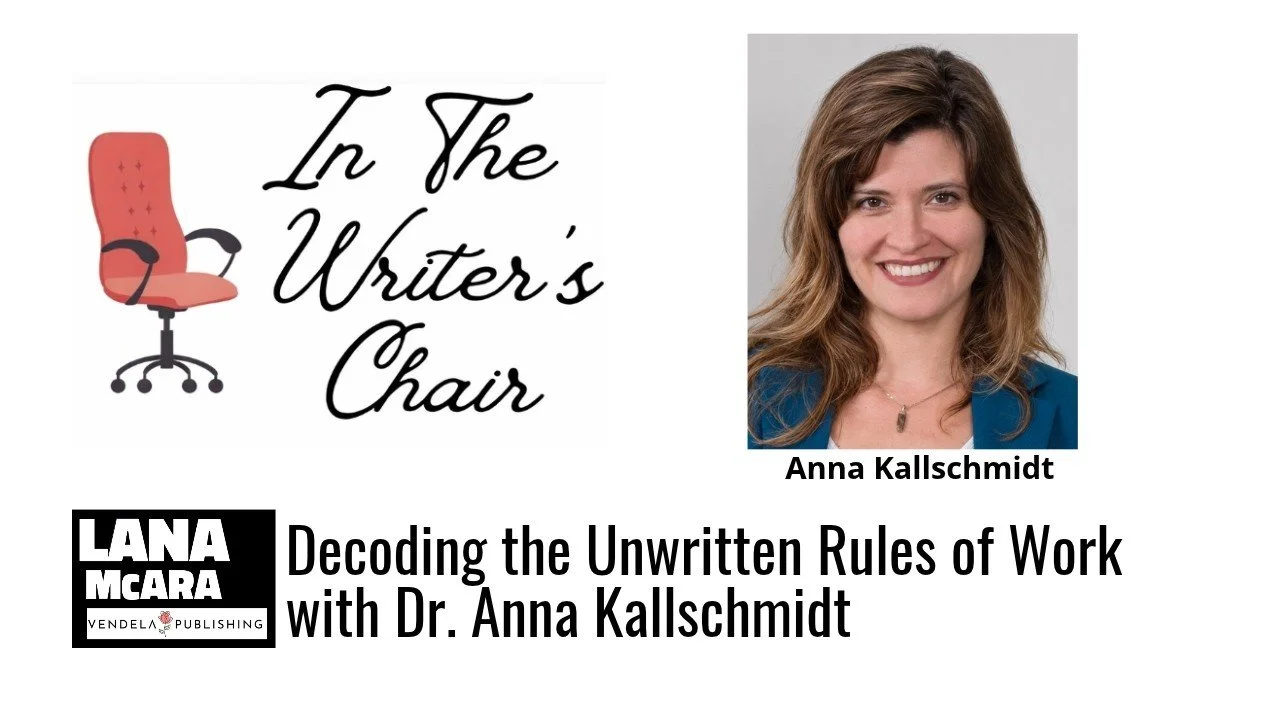
In the Writer's Chair with Lana McAra
What happens when the expectations that shape your career are never explained?
In this episode of In the Writer's Chair, Lana McAra welcomes Dr. Anna Kallschmidt, an industrial-organizational psychologist, researcher, and author of The Unwritten Rules of Work.
Their conversation explores how unspoken workplace expectations influence communication, career advancement, and the ability to contribute meaningfully at work.
When Workplace Rules Aren't Written Down
Dr. Kallschmidt's research identifies eight unwritten rules that employees encounter as they advance professionally.
One involves the shift from communal working-class environments, where cooperation and direct communication are valued, to corporate cultures that often reward individual achievement, self-promotion, and indirect communication.
Lana recalls her own experience working in corporate publishing, where answering a question directly during a meeting seemed to make everyone uncomfortable.
Dr. Kallschmidt explains that employees may be expected to recognize these subtle expectations without anyone actually teaching them.
The Hidden Cost of Staying Silent
One particularly important rule involves compliance.
Employees may be encouraged to share ideas while simultaneously receiving signals that disagreement isn't welcome.
Dr. Kallschmidt warns that this creates problems beyond employee frustration.
When knowledgeable employees hesitate to raise concerns, organizations can miss important information, make costly mistakes, or overlook potential dangers.
Both Lana and Dr. Kallschmidt question the value of hiring people for their expertise if they aren't encouraged to use it.
Why Unspoken Expectations Affect People Differently
The conversation also explores how workplace expectations affect neurodivergent employees, including people with autism or ADHD.
When communication depends heavily on reading contextual clues, individuals who process those signals differently may encounter additional challenges.
Dr. Kallschmidt emphasizes that these barriers don't necessarily reflect someone's ability to perform their job.
Simple workplace accommodations can also make a meaningful difference.
Lana shares her sensitivity to strong scents, while Dr. Kallschmidt describes receiving an office accommodation after experiencing severe light sensitivity following a concussion.
Turning Research Into Practical Change
Growing up in a blue-collar Florida community helped shape Dr. Kallschmidt's interest in social class and workplace expectations.
Today, she works with organizational leaders and professionals through workshops, coaching, and an online community.
Her goal is to help people recognize expectations that often go unspoken and create workplaces where different perspectives are valued.
Throughout the interview, one message becomes clear: better communication begins when we stop assuming everyone understands the same rules.
Watch the full conversation with Dr. Anna Kallschmidt on In the Writer's Chair.
Join our writer's community IN THE WRITERS STUDIO for connection with other writers, free training in writing craft and up-to-date marketing techniques, and practical insights that will make your life easier.