
When a Character Is Closed, Use a Key to Open Them Up
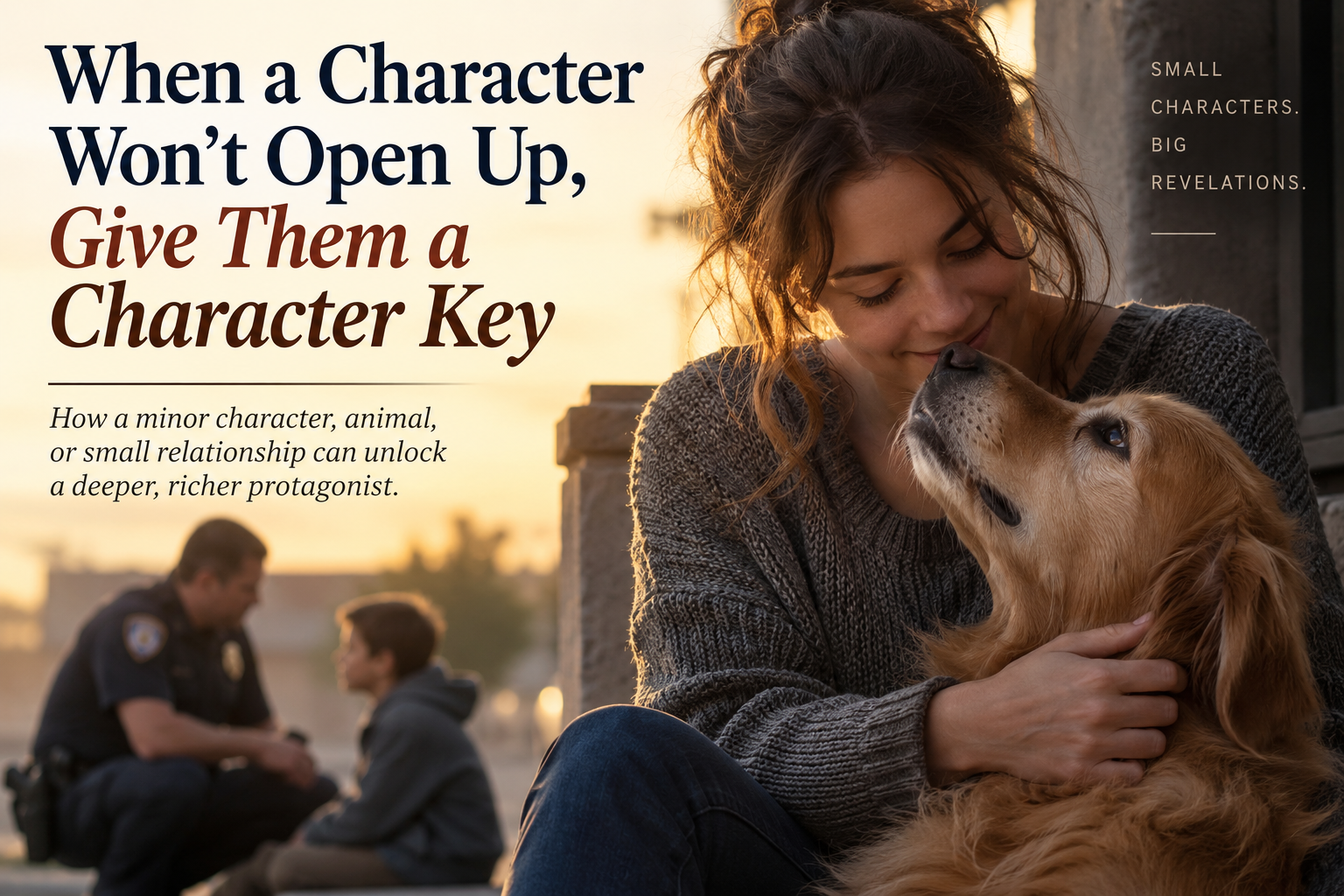
Sometimes a character zips their lip and refuses to cooperate.
You know who you want them to be. You know what you want them to do. You know their backstory. But when you put them in a scene, they seem flat, lifeless… boring.
When that happens, adding more backstory or description isn't always the answer. Sometimes the best way to add depth to a character is to give them someone, or something, that allows another side of them to emerge.
I ran into this problem in one of my early novels, now titled Tara’s Dilemma. Tara was the female love interest and main character, but I couldn't figure out how to make her layered and nuanced like the characters I loved to read about.
This is the book I wrote (and rewrote) for fourteen years. Still, Tara was two-dimensional. She said all the right words, but she had no LIFE.
One day, I woke up with a new idea.
I brought in a dog.
A stray dog showed up in the ranch yard, and she enticed him with food and kind words. She named him and sat on the porch step to talk to him.
Suddenly, Tara came alive.
She told him things she wouldn't tell another soul. Finally, she opened up to show her vulnerability, humor, fears, and tenderness without telling us about them.
The dog wasn't particularly important to the plot.
He was important to her.
I've come to think of this storytelling device as a Character Key, a minor character, animal, object, or relationship that unlocks traits in a major character that would otherwise be difficult to reveal naturally.
A Minor Character Can Do a Major Job
A Character Key doesn't need a story arc. They may have very little space on the page.
Imagine a hardened police officer who keeps everyone at arm's length. If you tell readers that he has a compassionate side, they yawn and put down the book.
Then, maybe you introduce a homeless boy.
Maybe the officer buys him a hamburger and discovers the kid is smart and likable. Eventually, he takes the boy home.
Now we see something completely different in the officer.
The boy doesn't change the plot, but his presence gives the officer a chance to show what he's made of rather than simply telling us.
That's much more powerful. It's also part of what makes a character feel credible to a reader. As I explored in Writing on a Knife's Edge: Balancing Suspense, Credibility, and the Cringe Factor, readers will accept discomfort and complexity as long as they continue to believe the character and the story.
The Key Doesn't Have to Be Human
Almost anything can become a Character Key.
Dogs work beautifully because people frequently behave differently with animals than they do with other people.
A hardened woman may become extraordinarily gentle around an elderly neighbor.
A businessman obsessed with money may secretly tend his late wife's garden.
A teenager who barely speaks to his family may chatter endlessly to his little sister.
A ruthless attorney may stop every morning to feed a stray cat behind his office.
Each creates an opportunity to reveal contradiction, and contradiction is where characters become interesting.
The ruthless man who is ruthless all the time is predictable.
The ruthless man who carries dog biscuits in his $2,000 suit because a scruffy terrier waits for him outside the courthouse makes us curious.
Now we want to know more.
When You're Stuck, Don't Bully Your Character
When writers come upon a flat character, they often pile on more backstory, more internal thoughts, or more description. They push the character around, hoping that will help.
It doesn't.
Instead, try giving the character a relationship.
Ask:
What would make this person behave differently?
Who needs something from them?
Who brings out their protective instincts?
Who makes them laugh?
Who can they confide in?
And don't assume another important character has to be involved. Sometimes, the perfect choice is someone who walks onto the page for only a handful of scenes.
The Character Key isn't there because we need to know them better.
They're there because, through them, we finally get to know someone else.
And sometimes that tiny addition clicks into place and opens everything.
Want more practical ways to strengthen your writing and develop characters readers care about?
Join our writer's community IN THE WRITERS STUDIO for connection with other writers, free training in writing craft and up-to-date marketing techniques, and practical insights that will make your life easier.